

Abstract
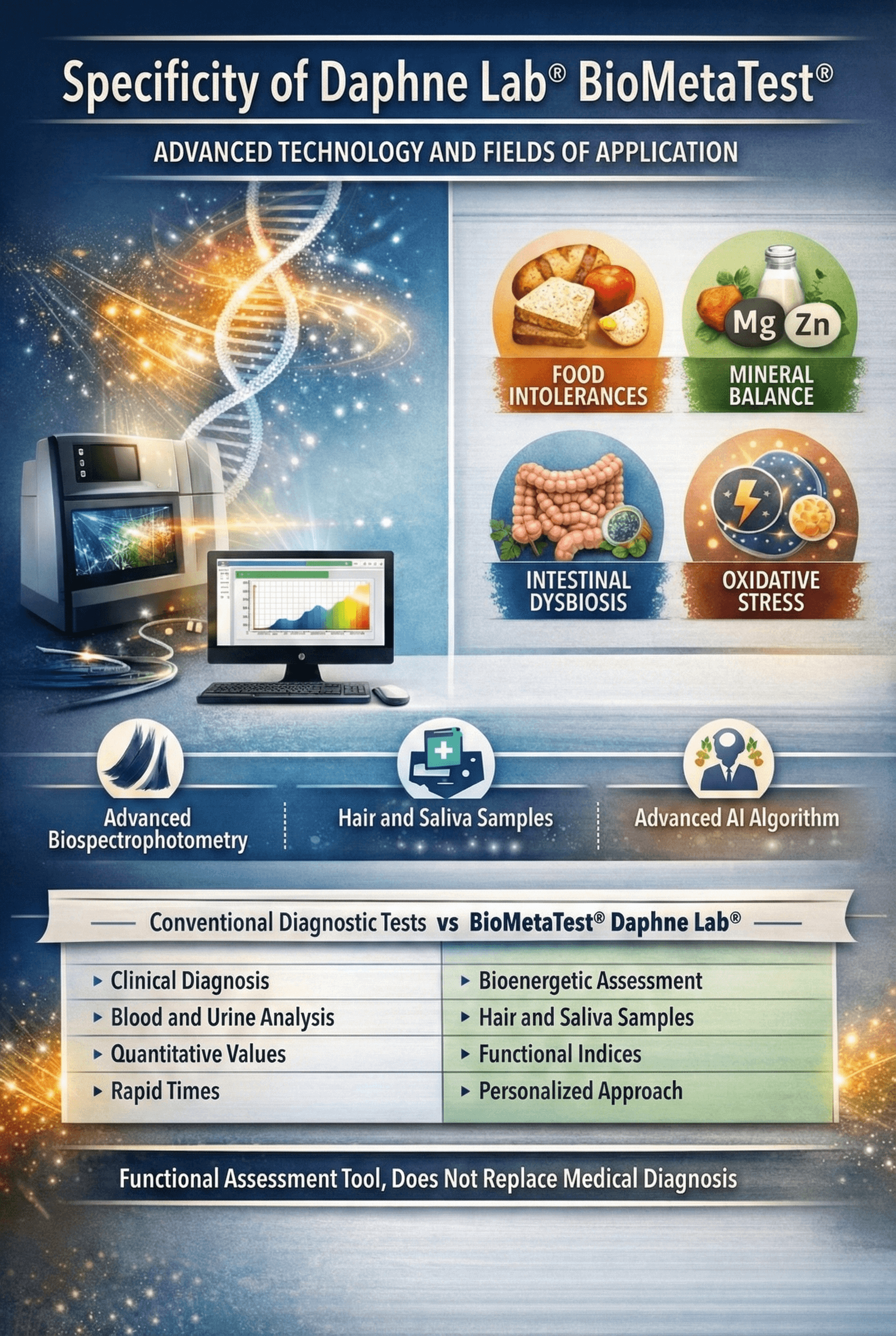
Daphne Lab® BioMetaTest® represent a family of third-generation biofunctional tests that employ advanced biospectrophotometric methodologies to assess the bioenergetic status of numerous aspects of human physiology, including nutritional intolerances, intestinal dysbiosis, mineral balance, and oxidative stress. This article analyzes the specificity of these tests in terms of technology, analytical capabilities, and potential clinical applications, clearly highlighting their methodological nature and limitations in comparison with conventional diagnostic examinations.
Introduction
In recent years, there has been growing interest in diagnostic and functional assessment tools that go beyond traditional clinical tests, moving toward preventive and personalized medicine. Within this context, Daphne Lab® has developed the BioMetaTest®, a set of biofunctional tests designed to investigate metabolic and bioenergetic aspects of the organism through the analysis of biological samples such as hair or salivary swabs, integrated with advanced data-processing algorithms.
Methodology: Technology and Analytical Specificity
The main distinguishing feature of the BioMetaTest® lies in the use of third-generation biospectrophotometric technologies which, through the amplification of microsignals derived from biological samples (hair matrix, blood, saliva, etc.), analyze a wide spectrum of bioenergetic and biophysical variables. This technology, known as Palladium Technology, is patented and is capable of detecting weak biofrequency signals, assigning each element or compound a percentage-based assessment of “functionality” or “biointolerance.”
The tests are built on mathematical models and meta-analytical genetic algorithms that process the collected spectral data and generate a detailed functional report. The methodology is implemented through an artificial intelligence–assisted decision-making system, designed to interpret detected parameters in relation to categories such as foods, minerals, metabolites, or biophysical indices.
Fields of Application of the BioMetaTest®
BioMetaTest® explore several functional areas of the organism:
- Nutritional intolerances: Bioenergetic analysis of individual responses to over 600 foods, with qualitative interpretations of potential “biointolerances” and personalized dietary recommendations.
- Functional mineral profiling and toxic metals: Assessment of minerals, trace elements, and potential environmental toxins through a biofunctional approach.
- Intestinal dysbiosis: Analysis of intestinal indices, digestive enzymes, amines, and biophysical aspects related to gastrointestinal flora balance.
- Metabolism and oxidative processes: Tests aimed at investigating cellular metabolic processes and oxidative stress through bioenergetic indices.
Each test provides a functional rather than quantitative perspective, oriented toward the evaluation of bioenergetic disturbances or areas of potential biological imbalance.
System Reliability and Quality
The analytical technology underlying the BioMetaTest® has been the subject of pilot studies conducted by Italian healthcare institutions, including ASL and AIAS, which assessed repeatability up to 94% in blinded studies on volunteers, with an estimated margin of error below 6%.
Additional scientific research has contributed to confirming very high reliability rates and supporting the effectiveness of the BioMetaTest®, including:
- A multicenter study on Italian patients conducted by Prof. De Bonis to evaluate the clinical reliability of the BioMetaTest®, which demonstrated significant results. Overlap analysis between BioMetaTest® outcomes and conventional clinical analyses showed a correspondence and similarity rate of 91% for data obtained from the same patients, along with a 95% rate of achievement of agreed therapeutic goals.
- A study conducted in the Balkans involving 3,700 patients to validate result quality.
- A scientific study dedicated to the analysis of test specificity and sensitivity.
- A scientific study on sensitivity and specificity that will soon be published in the international peer-reviewed journal JDream.
Furthermore, Daphne Lab® laboratories operate according to certified quality standards: ISO 9001 for quality management systems and ISO 14001 for environmental management, including rigorous quality controls on biospectrophotometric equipment and analytical processes.
Discussion: Comparison with Conventional Clinical Tests
Despite their structured methodology and advanced analytical tools, BioMetaTest® must be properly contextualized:
- Non-diagnostic nature: The reports generated do not constitute medical diagnoses and do not replace standard clinical examinations recognized by national healthcare systems. They are non-clinical functional or bioenergetic assessment tools, particularly useful in preventive and integrative medicine.
- Specialist interpretation: Results require professional interpretation by physicians or qualified specialists, integrating findings with medical history, symptoms, and conventional diagnostics.
- Scientific validation: Daphne Lab® BioMetaTest® have undergone multiple evaluation studies, supporting their proven analytical reliability.
Conclusions
Daphne Lab® BioMetaTest® offer an innovative biofunctional approach with a broad spectrum of assessments applicable in functional medicine and personalized prevention. Thanks to patented third-generation technology and certified quality management, these tests represent useful tools for providing detailed bioenergetic information when interpreted with professional rigor. Nevertheless, given their non-diagnostic nature, it is essential to integrate them with conventional clinical evaluation for proper planning of nutritional, metabolic, and wellness interventions.
Comparative Table: Conventional Tests vs Daphne Lab® BioMetaTest®
| Feature | Conventional Diagnostic Tests | Daphne Lab® BioMetaTest® |
| Primary purpose | Diagnosis of defined diseases or clinical conditions | Functional and bioenergetic assessment of organism status |
| Approach | Analytical, quantitative, based on biochemical parameters | Systemic, qualitative-functional, personalization-oriented |
| Clinical recognition | Recognized by guidelines and healthcare systems | Non-diagnostic, complementary tools |
| Type of result | Numerical values with standardized reference ranges | Functional indices and bioenergetic response percentages |
| Personalization | Limited (population-average ranges) | High, based on individual response |
| Biological samples | Blood, urine, stool, biopsies | Hair, saliva, biological swabs |
| Repeatability | High, standardized | High internal repeatability |
| Turnaround time | Variable, often rapid | Moderate, approx. 3 working days |
| Preventive assessment | Limited (often pathology already present) | Prevention- and subclinical imbalance–oriented |
| Multifactorial analysis | Sector-based (one parameter at a time) | Integrated (metabolism, PNEI, microbiota, nutrition) |
| Food intolerances | Specific immunological tests (IgE/IgG) | Bioenergetic analysis of individual response |
| Gut microbiota | Microbiological or genetic analysis | Functional/bioenergetic dysbiosis analysis |
| Stress and PNEI axis | Indirect or separate assessments | Integrated psycho-neuro-endocrine-immune evaluation |
| Environmental factors (e.g., EMF) | Generally not assessed | Included in functional analysis |
| Clinical use | Diagnosis, therapeutic monitoring | Decision support in functional medicine |
| Interpretation | Standardized medical interpretation | Requires specific training and clinical integration |
Methodological Note
BioMetaTest® do not replace conventional diagnostic tests but represent supportive tools within functional medicine, clinical nutrition, and personalized prevention, integrating traditional clinical data.